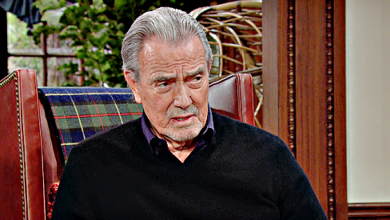
Audra exposes the lie and shocking DNA results – Claire is not Victoria’s child CBS Y&R Spoilers
The Young and the Restless spoilers.
Audra had always understood that power in Genoa City was not merely a commodity traded across boardroom tables, but a living organism fed by narrative, lineage, and the precision of timing.
And once she decided that Clare had stolen time and narrative from her, she treated the problem with the same methodical intensity she once reserved for hostile takeovers.
The objective was brutally simple. Expose the weakest seam in Clare’s story and pull until the entire costume collapsed.
That seam lived in the past — in the seasons when Clare had lived under Jordan’s roof and learned to weaponize humility, in the years before headlines and board badges, where identities could be switched like luggage tags and sentiment could be forged more easily than a passport.



Audra began by collecting the public record everyone else had politely accepted and then refused to accept it. She cross-referenced dates and addresses, compared the cadence of old medical notations against the way computers timestamp every keystroke, interrogated the way a baby bracelet’s code appeared in one file but not another, and followed Jordan’s money rather than Jordan’s mouth.
She constructed a quiet map from Midwestern clinics to lakeside rentals to a storage unit off an unremarkable frontage road, and she moved through it as if she were walking a labyrinth she had built herself.
Each breadcrumb was small and plausibly deniable on its own — a receipt here, a lease renewal there, a voice message saved to an old cloud account that a less suspicious person would have deleted. But together they made a music too coherent to ignore.
What began as suspicion clarified into evidence.
An intake ledger from a private maternity practice listing a delivery on a date that would place Clare’s age outside the window everyone had learned to parrot.
A series of transfers from Jordan to a midwife named Eleanor with the kind of irregular frequency that suggests pressure rather than gratitude.
A set of photographs of an infant in a knit cap with a hospital code that did not match the one on the bracelet Victoria keeps in a drawer — as if keeping an artifact could overrule the universe.
Audra did not rely on any one proof because one proof can be discredited. She layered corroboration until the only way to refute her would be to call reality itself a liar.


Victoria’s resistance became, ironically, part of the story’s structure. The refusal to authorize a new test had begun as a maternal boundary erected against the indignity of reliving an old violation.
But as months went on, the boundary crystallized into an article of faith. She would not let the town or rivals or regret define the only relationship that had felt like a second chance delivered by fate.
That refusal, noble in private, read as theater in public, and Audra exploited the optics without ever using the word exploit. She let the image of a mother guarding her child stand, then placed beside it — gently at first, and then with more force — the record of a different mother who had been erased.
Eleanor lived far from the circles that take their coffee with a side of intrigue. A woman whose life had been shrunk by a sequence of mistakes and a bruising encounter with Jordan years ago. She had kept in a shoe box built to outlast shame the things that institutions forget to delete.
A duplicate of the page where she had signed away guardianship under duress. A Polaroid with a date stamp that predates the photo Victoria holds. A hospital anklet with a code that matches the ledger Audra unearthed.
She had also kept a voice message that a desperate woman had once left for her — a message in Jordan’s controlled tone promising payment for discretion and hinting at consequences if silence failed.
When Audra sat with Eleanor, she was not cruel. She knew that holding up the past to the light can blind the person who must look at it. She asked questions the way a surgeon asks for instruments — precise and without malice. And she documented everything twice, because the only thing more dangerous than a fabricated story in this town is a true one poorly recorded.
The chain pulled itself tighter around Jordan with each step Audra took. Flights stitched a pattern between lake houses and little airports no one uses unless they prefer not to be noticed. Rental contracts in Jordan’s name corresponded with months in which Clare’s whereabouts had been oddly vague.
A storage unit that renewed year after year contained the sort of archive only a control addict would curate — clipped articles about Victoria, lists of wineries she favors, a handwritten calendar of Newman events, draft letters designed to be sent from a daughter that did not yet exist, test kits purchased but never mailed, and folded into a book of prayers, a note in a cramped hand that read like a blueprint for the performance Clare would later pull off.
The more Audra saw, the less she believed in coincidence.
When she discovered a transfer from a shell company to a private investigator known for washing documentation until it is clean enough to be framed — and when that investigator’s notebook included entries referencing hair strands collected from a hotel brush and a disposable razor thrown away near a gym — she understood the trick that had fooled an entire family.
Tests had been steered, not forged. Chain of custody compromised with the finesse of someone who knows that a result can be made to say anything if you control the logistics of how it is spoken.
Audra made duplicates, encrypted them twice, tucked them in a place even she would not casually check, and then she did the thing that separates a strategist from a gossip — she built a narrative that could survive hate.
It wasn’t enough to be right. She needed to be undeniable.
Every investigation has a moment when discovery collides with motive. And for Audra, that collision arrived at the same time her ambition reframed itself as a kind of justice.
She told herself, in the most private corner of her mind, that exposing the lie was not merely a career move or an act of vengeance against a rival. It was an inoculation against the city’s favorite disease — the one where power puts a benevolent label on manipulation and calls it destiny.
She also told herself, less nobly but with equal conviction, that stripping Clare of the borrowed aura she wore would reopen a door with Kyle that had been slammed on her fingers too many times to count.

Winning Kyle back would never be as simple as a truth detonated at the right party.
But it would remove the halo that had turned every argument into a referendum on Clare’s sanctity.
In the calculus she practiced without apology, truth and desire could be carried in the same equation.
She prepared her reveal like a product launch — because that is the language she speaks best. She timed it for a day when Victoria would be least likely to vanish behind a gate and most likely to be surrounded by people who would force her to listen.
Not because humiliation interested her, but because denial is hydrophobic and needs the pressure of witnesses to dissolve.
She lined up a boardroom presentation that looked like any other — until the slide deck refused to talk about market share and began to talk about blood and lies.
She wrote a statement clean enough to sound generous and cutting enough to leave no exit.
A statement that did not gloat, did not sneer, did not name names more than necessary — but did insist that facts be allowed to matter again.
Clare sensed the weather shifting before anyone told her why.
The town has a way of tilting on its axis when a new story is about to be fed to it, and people who have spent their lives learning to read the air can tell when the oxygen content has changed.
She noticed text threads where she used to be tagged going silent. She noticed the way Nikki’s compliments suddenly lost their adjectives. She noticed the unhelpful politeness in Adam’s eyes — the sort that indicates a man has chosen to observe in case observation becomes useful later.
She told herself to breathe, told herself that recovery is not linear, that a past under Jordan’s command is not a life sentence, that the person she has built since stepping into the house she once attacked is not a costume.
She believed it because she had to.
She also believed, with a fear that felt like falling, that Audra was coming for her.
When she finally cornered Audra in a place where cameras were not welcome and the echo of footsteps could still be heard, she did not bargain with lies.
She asked for time — just time — for the space to manage the revelation in a way that did not explode the fragile structure she had managed to erect with Victoria and the family that had decided to believe in her.
She asked for the chance to find Eleanor herself and determine whether there was any mercy left in the story.
She said, without flourish, that her love for Victoria had become real, even if its origin had been scripted, and that tearing that apart would not create justice.
It would create rubble.
Audra heard every word — and for a moment, a hand she rarely offers to her own conscience reached toward her.
Then the cooler part of her mind resumed control.
Mercy without accountability mimics the same disease she was trying to cure.
She told Clare, not with cruelty, but with the uncompromising tone of a woman who has decided to choose the version of history that punishes her enemies and rewards her strategy, that the time for quiet had ended.
The day of the reveal did not announce itself with thunder.
It unfolded with the casual brutality of any ordinary day that becomes historic by noon.
The boardroom looked like it always looks before something irretrievable happens — polished wood and fluted water glasses. A screen that had projected a thousand sanitized lies and a thousand genuine ideas.
Victor entered late in the way men enter late when they want their lateness to be a character in the scene. And he sat with a posture that communicates both welcome and warning.
Nikki arranged an expression that has seen more wars than most people’s entire families and still knows how to smile sincerely when given a reason.
Victoria came armed with the only armor she trusts these days — the belief that believing is a virtue that should not be punished.
Cole kept his counsel with the frown of a man who has seen stories warp the people he loves into props and would prefer to opt out this time.
Kyle stood near a pillar, not expected to speak, but always prepared to lean into a moment if the moment could be made to lean back.
Audra spoke.
She walked them step by step through a timeline that did not rely on their memories, but on the way ink dries on paper.
She did not dramatize Jordan’s cruelty — the facts performed the drama without needing stage directions.
She described the clinic, the ledger, the coded bracelets, the money. She nodded toward Eleanor without hauling her into a room where she would be consumed.
She demonstrated, with the remedial patience of a teacher who has grown tired of watching smart people pretend not to understand, how a result can be managed by controlling the hands that carry the sample from bathroom to laboratory.
She ended without triumph.
She ended with a question no one could answer without coughing up a piece of their pride:
What do we do when love has been built on a foundation that a predator poured?
Silence is not a single thing. It comes in species — some predatory, some defensive.
And the silence that followed Audra’s last slide was the dangerous kind that detonates later.
Victoria absorbed it in the way only a woman who has fought for a story can — with that terrible stillness that signals damage has occurred, but dignity refuses to drop the vase it is holding.
She did not cry. Crying would have been a release she did not feel entitled to in a room full of rivals.
She did not deny. Denial would have been generosity to the person presenting the case.
She did what true power does when confronted with a past that might be a lie.
She separated love from origin and chose the first over the second.
She said, in a voice that had not found its tremor yet, that whatever the blood says, the choice to be a mother is a daily act and not a historical fact.
It was brave.
And it was insufficient to stop the machinery that a public revelation sets in motion.
Nikki’s mouth made the shape of support, even as her eyes inventoried risk.
Victor contemplated the upside of a story that might remove a distraction from his line of succession — while simultaneously wondering whether the cost of the removal would weaken his house.
Cole looked at Clare with a complicated mercy that counts as love, even when it cannot call itself that without breaking.
Kyle did not look at anyone for a long ten seconds.
He felt the floor shift in the useful way he had hoped it would — the way that removes the automatic sheen from Clare’s skin.
The way that frees a man to tell himself that his worst decisions with Audra are now forgivable, because he has in some ugly way been right about Clare all along.
He did not say any of that.
He let the story settle and began to revise himself in it.
After the meeting, the town did what the town always does — it tried to metabolize the shock by chewing it loudly in corners of restaurants where intrigues are plated as appetizers.
People remixed the facts into whatever genre best served their appetite.
Some decided Audra was a savior, correcting an injustice the city’s royalty would have gladly framed as fate if left unchallenged.
Some decided she was a vulture, preying on a survivor’s attempt to rebuild herself by ripping at the oldest wound she had.
Others decided the only story worth telling was the one where Jordan, even from a distance, still ran the table — by making everyone else argue about the pieces she had arranged.
Clare did not attend any of those meals.
She went home to a quiet place where the air could carry the weight she could not share yet — and she called the woman whose name had been spoken in that room without being dragged into it.
The conversation did not heal anything. Healing is not a transaction.
It did, however, introduce a possibility Clare had not prepared for — that the past she survived might not be the past she remembered.
That she had been both a participant and a product, an actor and a prop.
And that the best atonement she could offer would be to step away from a pedestal she never deserved, and build a life that did not use debt and pity as its columns.
She understood, with a fear that felt almost freeing, that love could remain even if a title disappeared.
Audra did not celebrate in public.
Victory is more durable when it is not flaunted.
And besides, the goal had never been applause. It had been recalibration.
She waited for the calls that mattered and returned only those that advanced the new alignment she sought.
Kyle’s call came early — a conversation that did not require theatrical forgiveness, because it floated on the implicit agreement that what she had done had removed the main obstacle to the version of themselves he prefers.
She allowed herself the quiet satisfaction of a checkmate executed without raising her voice.
She also absorbed, with the discipline she has earned, the new burden she had taken on.
Toppling a false identity does not automatically deliver a clean story.
It leaves behind ruins that decent people must decide not to live in.
Nate watched all of it with the tired wisdom of a man who understands that truth can be used like a scalpel or like a club — and that the same fact can save one person and injure another in the same hour.
He remained kind to Audra without becoming her accomplice, because love that gives up on scrutiny turns into a blindfold too easily in this town.
He visited Clare once when no one would notice.
Not to resuscitate a relationship that had never been his, but to insist — with the simple weight of presence — that a person is not a plot twist, not a headline, not a blood result, but a sequence of choices available each morning until the last one.
Consequences unfolded with the incremental cruelty of paperwork and the occasional burst of public spectacle.
Legal teams skirmished over the phrasing of statements so that words like alleged and confirmed could do their usual tedious dance.
Media arms of the family adjusted their tone by half steps until audiences learned how to react without instruction.
The house that Victoria had opened to Clare made space for the possibility that an error had been perpetrated at the threshold — and yet, the people inside it refused to let outsiders declare who is and is not family, as if DNA were a security badge.
Victor recalibrated alliances with the smooth ruthlessness he saves for weeks that determine seasons.
Nikki offered a bridge wherever one could be built without collapsing under sentimentality.
Cole allowed himself the smallest hope that a revelation that demolishes a fantasy might bless them with something more honest than fantasy could ever provide.
Kyle, emboldened by the collapse of Clare’s halo and seduced by the sophistication with which Audra had engineered it, began again to see a future where the two of them could be the elegant couple the city loves to watch — and loves to blame.
A future where ambition and affection do not sabotage each other, but perform their duet.
Audra, sharper than ever and also strangely softer in the hour after victory, recognized the paradox she would need to manage if she wanted that duet to last.
The very skill that had delivered her triumph could also starve any relationship that required mercy to breathe.
In the end, the story did not deliver the uncomplicated catharsis that lesser cities build their myths on.
It delivered something more interesting — and more difficult.
It left Clare with a path that does not rely on borrowed names.
A path that will require apologies no one can script and strength that cannot be bought.
A path where staying near Victoria might be a daily negotiation grounded in love, rather than in the narcotic of destiny.
It left Victoria with a love that must now declare itself every day in the absence of the easiest rationale — which is to say, it left her with a love that looks more like the real thing than any test could certify.
It left Audra with the spoil she wanted and the moral invoice that accompanies every victory that costs another woman her shelter — an invoice she will either pay by building something that justifies the damage, or default on by pretending damage is a synonym for justice.
It left Kyle with an opening and a mirror.
If he walks through the first without looking into the second, he will repeat the same loops that made him cruel the last time his heart felt cornered.
And it left Genoa City with the reminder that stories here are not settled by revelation alone, but by what people do after the lights fade.
When files have been archived and headlines have moved on, and the only witnesses left are the ones in the mirror.
Audra promised herself that she would not squander the moment. She had worked too hard to assemble facts from ashes to let the next chapter be written by inertia.
Clare promised herself that she would not disappear.
Not because defiance makes better television, but because disappearance is exactly what Jordan always wanted of her.
Victoria promised herself nothing except to show up tomorrow — and again the day after — because that is what real mothers do.
And the town, thrilled and exhausted as usual, turned the page.
Already hungry. Already weary.
Already learning the lesson it never remembers for long — that in Genoa City, the past is not prologue.
It is infrastructure.
And those who understand how it is built can change the skyline in a single afternoon.